
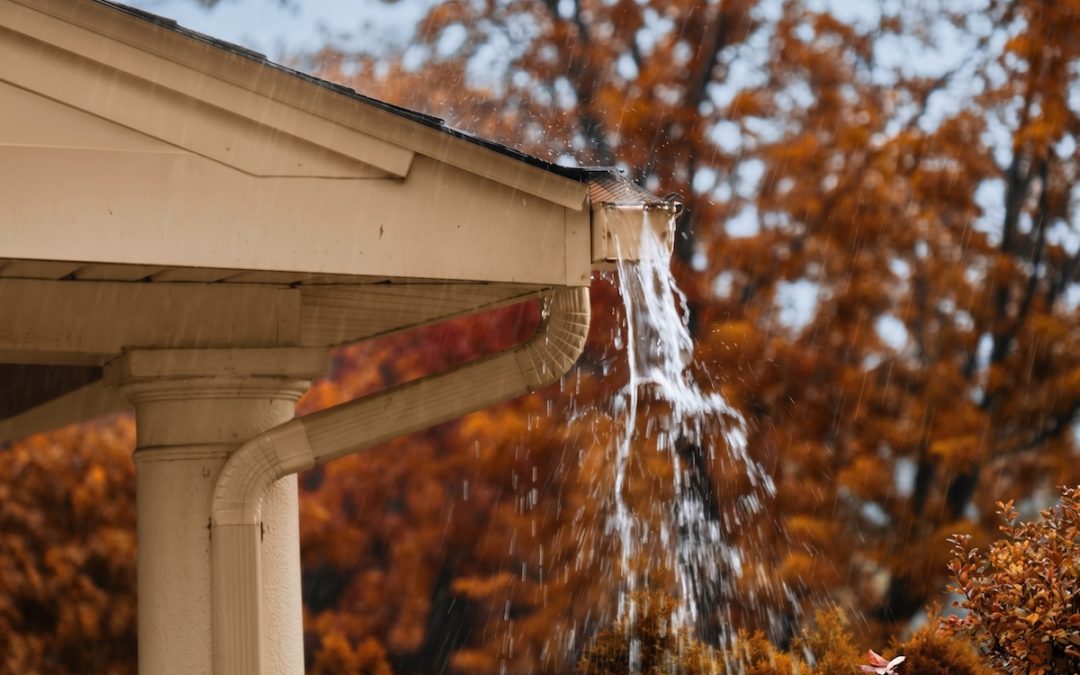
Picture it: a heavy storm rolls through, and instead of draining cleanly, water sheets over the top of your downspout, sluicing down the siding and hammering the mulch bed into a muddy fan across the foundation. If your downspout is overflowing, it’s usually one of six things:
- A gutter clog
- Too few or undersized downspouts
- A disconnected or poorly pitched downspout
- Rainfall that’s simply outpacing the system
- A frozen or ice-dammed line in winter
- A buried drain that’s clogged underground
Here’s the bottom line: an overflowing downspout isn’t a tidiness problem – it’s the early warning light on your dashboard. All that water dumping next to the house soaks the soil against your foundation, finds its way into the basement, and quietly rots out the fascia behind the gutter. Left alone, a zero-fix today becomes a four- or five-figure repair later on.
Van’s Rain Gutters has been keeping water off South Jersey homes since 1948. Veteran-owned, we’ve been on these roofs long enough to know exactly what makes a downspout in give up during a storm.
The 6 Causes of an Overflowing Downspout
Most overflowing downspouts trace back to one of the six causes below. We’ve ordered them roughly from most to least common for South Jersey homes.
Cause 1: A Clog Deep Inside the Downspout
The most common cause by far is that debris is packed somewhere inside the tube, and water can’t get past it.
| What It Looks Like | Water gushes over the top during rain; tapping the tube gives a dull thud instead of a hollow tonk. |
| Why It Happens | Leaves, pine needles, twigs, and shingle grit jam up at the top or bottom elbow. |
| How to Fix | Flush from the top with a garden hose, escalate to a drain snake, or unscrew the bottom elbow and clear it by hand. |
Cause 2: The Downspout Is Undersized for Your Roof
The downspout is too small to carry the volume of water your roof sheds in a hard rain, so the excess backs up and spills over the top.
| What It Looks Like | Drains fine in a light shower, but overflows like clockwork in every heavy storm. |
| Why It Happens | A 2″×3″ downspout handles ~600 sq ft of roof, and a 3″×4″ handles ~1,200. Many older South Jersey homes use a smaller size. |
| How to Fix | Upgrade to 3″×4″ downspouts (often paired with 6″ gutters), or add downspouts to split the load. |
Quick Tip: Is your downspout big enough?
- Estimate the roof area draining to that downspout. Take the footprint of the roof section above it (length × width in feet) to get a rough square footage. (One downspout usually serves one or two roof planes.)
- Match it to capacity. A 2″×3″ downspout handles about 600 sq ft. A 3″×4″ handles about 1,200 sq ft.
- Compare. If the roof area feeding a single 2″×3″ downspout exceeds 600 sq ft, that downspout is overwhelmed in a hard rain. Either size up or add a second one to share the load. Note that heavy local downpours, roof pitch, and valleys that funnel water all increase the actual number.
Cause 3: The Gutters Aren’t Pitched Correctly
The gutter isn’t sloped enough toward the downspout. Water then pools in the trough instead of draining and eventually spills over.
| What It Looks Like | Standing water in the trough on a dry day, with debris collecting mid-run instead of at the downspout. |
| Why It Happens | Gutters need ~¼” of slope per 10 ft. Sagging hangers, house settling, or a flat original install offset the pitch. |
| How to Fix | Re-pitch the run by repositioning the hangers so it slopes toward the downspout. |
Cause 4: The Bottom Outlet or Elbow Is Blocked
Debris or ice has collected at the bottom bend of the downspout. Water backs up behind the blockage instead of draining out at ground level.
| What It Looks Like | Water spills out the top while little or nothing comes out the bottom (or just a weak dribble). |
| Why It Happens | The bottom elbow is the tightest turn and lowest point, so it collects debris like a drain trap. In winter, it freezes. |
| How to Fix | Disconnect the bottom elbow, clear it by hand, run a hose to confirm flow, and reattach. For ice, let it thaw or use warm water – never a torch or heat gun. |
Cause 5: A Section Is Damaged, Separated, or Disconnected
A piece of the downspout is dented, split at a seam, or pulled apart. Water escapes through the gap instead of running all the way down.
| What It Looks Like | A visible gap, dent, or twist; water spraying sideways from a seam, or the bottom loose from its splash block. |
| Why It Happens | Storms, falling branches, ladder hits, lawn equipment, or old fasteners finally give way. |
| How to Fix | Reattach loose sections with new straps and screws. Replace any dented, split, or crimped section outright. |
Cause 6: Your Home Doesn’t Have Enough Downspouts
There aren’t enough drain points for the length of the gutter you have, so water collects faster than the few downspouts can carry it away.
| What It Looks Like | Several runs feeding one downspout, or a 40 ft+ run with one drain. Overflow at the same corners every storm. |
| Why It Happens | Common in older homes and renovations where a downspout was removed. The rule of thumb is one per 30-40 ft of gutter. |
| How to Fix | Add downspouts where they’ll relieve the overloaded runs, tied in without throwing off the pitch. |
Quick Tip: Coastal and Wooded Communities
Living by the shore or in the heavily wooded stretches of Burlington and Camden? You may need more downspouts than the original builder specified.
Between the rainfall this region actually gets (summer thunderstorms, tropical-storm remnants, Nor’easters) and the constant debris load from oak and pine, a gutter system that was adequate on paper decades ago is frequently undersized for the real conditions today. If your downspouts have always seemed to struggle, it may not be a clog or a one-off. Instead, your system may have been short a drain point or two from the start.
How to Diagnose Which Cause You Have

You don’t need to guess your way through all six. Most overflowing downspouts give themselves away with a single tell – one thing you can see from the ground that points straight at the cause. Run through these five checks in order and stop at the first one that matches:
- Does the gutter hold standing water between rains? → You’ve got a pitch problem. The trough isn’t sloped enough to drain, so water sits and eventually spills.
- Does it overflow only in heavy rain, but drain fine in a light shower? → The downspout is undersized for your roof. It works until the volume spikes.
- Does it overflow in any rain, even a light one? → You almost certainly have a clog, the most common cause of all.
- Is water spraying sideways out of a seam mid-run? → That’s damage where a separated, dented, or split section is leaking where it shouldn’t.
- Are there several gutter runs feeding into one lonely downspout? → You don’t have enough downspouts for the roof you’re draining.
Remember that these aren’t always mutually exclusive. A clog and bad pitch often travel together, because a trough that won’t drain collects the debris that becomes the clog.
If more than one check matches, work through those causes in order; fixing the most obvious one first usually makes the next one easier to spot. And the blocked-bottom-elbow problem hides behind a couple of these, so if you’ve cleared the obvious culprit and water still backs up out the top, check that bottom elbow before anything else.
.When to DIY vs. Call a Professional
Some of these fixes are a reasonable Saturday job. Others aren’t worth the risk or will just come back if you patch them without addressing the real cause.
You can probably handle it yourself if:
- You’ve got a single-story home with ground-level outlets.
- The problem is a simple clog or a visible obstruction that you can reach.
- The fix is something like flushing a downspout with a hose, clearing a bottom elbow, or repositioning a splash block.
These are the low-risk, high-success DIY wins that you can knock out with a hose, a screw gun, and an hour.
It’s worth calling a pro if any of these apply:
- It’s a two-story home: Anything above the first floor means a tall ladder and a real fall risk.
- The overflow keeps coming back: More than once a season means the cause is structural (pitch or sizing), not just debris.
- It’s a pitch or sizing problem: Re-sloping a run or upgrading downspout size is install work, and getting it wrong just moves the overflow somewhere else.
- Water is already showing up in the basement or against the foundation: At that point, the clock is running on expensive damage, and you want it solved right the first time.
- It’s an ice-related blockage mid-winter: Frozen downspouts on a snowy, icy roofline are the most dangerous scenario of all, and the one most worth handing off.
Most gutter-related ER visits come from ladder falls, not from the gutters themselves. Simply put, a downspout problem is never worth a trip to the hospital.
If you don’t have a stable, properly footed ladder setup (and a second person to steady it), this is a situation best handled by pros. We’d rather walk you through what’s wrong over the phone than see you take a fall trying to reach it!
Preventing Future Downspout Overflows
Fixing the overflow is only half the job. The real challenge is keeping it from coming back, and it’s the cheaper half by a wide margin. A few habits will keep your downspouts clear through the worst South Jersey throws at them.
Clean Them on a Schedule, Not When They Fail
The single best prevention is regular cleaning. Ideally, you’re aiming for at least once a year, and twice a year if you’ve got oak or pine anywhere near the roofline (which, around here, most people do).
Spring and fall are the natural checkpoints. If keeping track of it is the part that never happens, that’s exactly what a maintenance program is for: someone comes out on a set schedule so a clogged downspout never gets the chance to become an overflow.
Add Gutter Guards That Actually Work
Quality gutter protection keeps the leaves, pine needles, and shingle grit out of the system in the first place, which is what causes most clogs to begin with.
The catch is that not all guards are equal; cheap mesh and foam inserts often clog as badly as the gutters they’re supposed to protect. In other words, it’s worth talking to someone who’s pulled failed guards off enough roofs to know what lasts.
Use Downspout Extensions to Move Water Away
Even a clear downspout does damage if it dumps water right at the foundation. A simple extension (either above-ground or buried) carries that water several feet out, where it can’t soak the soil against your basement wall. It’s one of the cheapest, highest-payoff upgrades on this whole list.
When Downspout Overflow Becomes a Foundation Emergency
Sometimes the overflow has already been doing damage before you notice it. If you spot any of these signs, the water has likely been reaching your foundation for a while – and it’s time to treat it as urgent rather than annoying:
- Cracks in your basement walls or floor, especially new ones, or hairline cracks that are getting wider.
- Efflorescence, or a chalky white powder, on the basement walls. That’s the mineral residue left behind when water moves through the concrete, and it means moisture is actively getting in.
- Mulch that keeps washing away near the downspouts, no matter how many times you replace it. The water is moving enough soil to carry it off.
- Soil eroding at the corners of the house, where downspouts tend to concentrate runoff.
- A damp basement after it rains – even hours later, once the storm has passed. Delayed water is still water that found its way in.
Here’s why this matters more in our area than in a lot of others. South Jersey sits on heavy, clay-rich soil, and clay doesn’t drain; it holds water and swells. When an overflowing downspout dumps storm after storm right next to the house, that saturated clay has nowhere to send the water but down along the foundation wall and, eventually, through it.
The pressure of all that waterlogged soil pushing against the concrete is what cracks walls and floods basements. It’s a slow problem right up until it’s a sudden, expensive one.
If you’re seeing any of those signs, don’t wait for the next storm to find out how bad it is. Schedule an assessment with Van’s; we’ll look at how your water is actually moving, where it’s ending up, and what it’ll take to get it away from your foundation for good.
Find Your Flow with Van’s
Van’s Rain Gutters handles the whole job, start to finish. Our team is licensed and insured, and we’re locals like you who know exactly how South Jersey’s storms treat a gutter system.
Simply get in touch with us to request a free estimate. No pressure, no obligation – just a straight answer about what your gutters need the most.