
Gutter guards are worth it for some homes and a waste of money for others. The deciding factor ultimately comes down to four things:
🌳 1 – Your trees | 🏠 2 – Your roof | 💧 3 – Gutter condition | ⏳ 4 – Ownership duration |
We’ve been on ladders across South Jersey since 1948, from Mullica Hill and Deptford out to Vineland, Mount Laurel, Salem, and down the shore to Ocean City and Cape May. We’ve installed gutter protection that has solved homeowner problems for 20 years. But we’ve also pulled off systems that never should have been installed on houses in the first place.
The short answer, before we get into the debris
Gutter guards are usually worth it if:
- You have mature trees within about 20 feet of the roofline
- Your property has a two-story or steep-pitch roof that makes ladder work genuinely dangerous
- Your gutters are in sound condition
- You plan to stay 7 years or more
Gutter guards are usually NOT worth it if:
- You have little overhanging canopy
- You have a single-story ranch you can safely service yourself
- Your gutters are already sagging or undersized
- You’re planning to move in the next couple of years
The honest middle: for many South Jersey homes, it’s close. When the math is a wash, the real question is how much you value never having to think about your gutters again.
What gutter guards actually do (and what they don’t)
What they genuinely do well
- Keep debris out of the trough: Leaves, twigs, seed pods, acorns, and roof grit stay out, so water keeps moving to the downspout.
- Cut cleaning frequency dramatically: For most homes, that’s the difference between two or three visits a year and an inspection every couple of years.
- Eliminate standing water: Standing water in a gutter is what turns a clog into a mosquito nursery.
- Reduce weight on the fascia: A 5-inch gutter packed with wet leaves is far heavier than most homeowners picture! That weight is what pulls gutters away from the house.
- Keep somebody in your household off a ladder: For a lot of our customers, this is the whole reason.
Claims worth pushing back on
“You’ll never clean your gutters again”
Not true, and it’s the claim that produces the most frustrated homeowners 3 years later. Every system needs periodic attention. Debris still collects on top of the guard. Mesh can glaze over with pollen or shingle grit. Roof valleys concentrate water and debris in one spot.
What guards actually do is change gutter cleaning from a recurring chore into an occasional maintenance item. That’s a real benefit. It just isn’t “never.”
“Guards prevent ice dams”
They don’t. An ice dam is an attic problem (namely insulation and ventilation) where heat escaping through the roof melts snow that refreezes at the cold eave. A gutter guard doesn’t touch that mechanism, though some designs give ice a wider surface to form on.
If ice damming is your true complaint, the conversation you need is about your attic, not your gutters.
“Guards fix your drainage problems”
If water is pooling against your foundation, the cause is usually:
- Undersized gutters
- Too few downspouts
- Downspouts dumping right at the wall
- Grading that slopes toward the house
Guards address debris. They don’t address volume or where the water goes once it leaves the downspout.
“Any guard works on any roof”
Roof pitch, shingle type, gutter size, and drip edge configuration all affect performance. We’ve seen guards installed on the wrong roof push water clean over the front edge in a hard rain – a house that never had an overflow problem before now has one.
What gutter guards cost in South Jersey
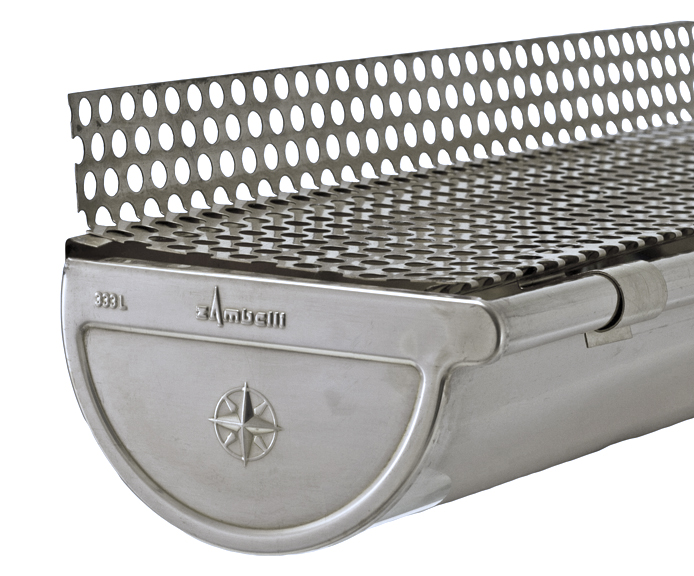
Here at Van’s, we install perforated aluminum panels (Shur Flo, Gutter RX, Leaf Relief), helmet-style aluminum (Leaf X), and stainless micro mesh (Leaf Blaster). We don’t sell foam or brush inserts, but they’re included in the table because you’ll be offered them elsewhere, and you should know what you’re looking at.
| Guard type | Installed cost per ft | 200 ft home | Realistic lifespan | Honest verdict |
|---|---|---|---|---|
| Foam insert | $2–$4 | $400–$800 | 2–5 years | Inexpensive for a reason. Traps seeds and grows plant matter. Skip it. |
| Brush insert | $3–$5 | $600–$1,000 | 3–6 years | Snags exactly what it’s meant to block. Stopgap only. |
| Vinyl/plastic screen | $3–$6 | $600–$1,200 | 3–8 years | Becomes brittle under UV and freeze-thaw. |
| Perforated aluminum | $8–$12 | $1,600–$2,400 | 15–20 years | Solid value against leaf debris. Won’t stop pine needles or shingle grit. |
| Helmet/reverse curve | $15–$30 | $3,000–$6,000 | 20+ years | Handles heavy leaf load. Can overshoot in downpours. Design-sensitive. |
| Stainless micro mesh | $12–$18 | $2,400–$3,600 | 20–25 years | The one that handles pine needles, grit, and coastal debris. |
What actually drives your numbers
- Linear footage: The biggest lever. A 1,400-square-foot ranch and a 3,200-square-foot colonial are not the same job.
- Stories and roof pitch: Two- and three-story work and steep pitches mean staging, longer ladders, and more labor hours.
- Gutter size and condition: Six-inch gutters cost more to guard than five-inch. And if the existing gutters are pitched wrong or pulling away from the fascia, guarding them just locks the defect in place.
- Roof complexity: Valleys, dormers, multiple rooflines, and inside corners add cost – and they’re where guard systems fail first.
- Removal and disposal: If there’s a failed guard system already up there, pulling it off is real labor.
- Fascia repair: The one nobody quotes upfront. Rotted fascia has to be dealt with before anything gets mounted to it.
The line item most quotes leave out
If your gutters are at the end of their life, a guard system is money spent on a component that’s about to be torn off.
This is why we assess the gutters themselves before we quote protection for them. Sometimes the honest recommendation is to replace the gutters and hold off on guards for now. Sometimes it’s to do both together – and we’ll show you why the combined cost beats doing them two years apart. Either way, you should hear it before you sign something, not after.
What you’re spending right now
You can’t judge the cost of guards without an honest number for the alternative.
If you pay a professional
Most South Jersey homes need clearing twice a year, and the timing isn’t arbitrary – seed pods and pollen come down in May and June, leaves in November and December. Tree-heavy lots often need a third pass.
That rhythm is why we run a Maintenance Program. Two scheduled visits, late spring and late fall: complete gutter and downspout clearing, all labor and equipment, and cleanup when we’re done. You get a call before the crew is en route, so it’s off your calendar entirely. Pricing is quoted per property ( access, total footage, and roof complexity all move it), and you see an itemized estimate before anything gets scheduled. The program covers guarded homes too, since clearing debris off the top of protection panels is part of the same visit.
Every visit, we’re looking at the system itself: loose fasteners, sagging runs, failed sealant at the seams. Anything that needs repair gets documented and quoted. That’s the difference between paying somebody to scoop leaves and having somebody actually watching your gutters year over year.
If you do it yourself
The out-of-pocket cost is low. Count the extension ladder, the stabilizer, the scoop, the wet-vac attachment – and two Saturdays a year, every year. Then count the ladder. Falls from ladders send tens of thousands of Americans to the emergency room annually, and work at the roof edge is heavily represented in that number.
We’re not raising it to scare anybody. We’re raising it because a lot of our customers cleaned their own gutters for thirty years, but reached a point where they shouldn’t be up there anymore.
If you skip it entirely
This is the expensive column, and it’s the one most homeowners underestimate.
- Fascia and soffit rot: Water spilling over the back edge soaks the wood your gutters are bolted to. Once the fascia is soft, the gutter has nothing to hold on to.
- Water at the foundation: On South Jersey’s clay soils and high-water-table lots, chronic overflow at the foundation is how you end up with a wet basement or crawlspace.
- Erosion: Beds, mulch, and hardscaping directly under the drip line take a beating.
- Standing water and mosquitoes: A real nuisance issue in Cumberland, Salem, and the shore towns.
- Pests and nesting: Squirrels, birds, and wasps treat a debris-packed gutter as move-in-ready habitat with a direct path to the soffit.
- Gutters torn loose: Packed debris plus a hard freeze is what finally pulls a run off the house.
The South Jersey variables that change the answer
Your trees decide this more than your budget does
The older tree-lined streets of Haddonfield, Collingswood, Moorestown, Merchantville, and Mullica Hill produce heavy leaf drop plus acorns, maple samaras, and sweetgum balls. Perforated aluminum and micro mesh both perform here. Foam and brush inserts don’t.
Along the Pine Barrens edge running through Burlington, Atlantic, and Cumberland counties, pine needles thread straight through standard screens and perforated panels. We say this plainly: the perforated aluminum products aren’t our recommendation when pine trees are close to the house. Tulip poplars behave the same way. If you’re pine-adjacent, micro mesh isn’t an upgrade – it’s the only category that actually works.
Coastal homes – Cape May and Atlantic counties
Salt air is corrosive, and low-grade materials show it fast. Stainless mesh and quality aluminum are the durable choices in Cape May, Wildwood, Ocean City, Sea Isle, and Ventnor.
Shore debris also behaves differently. Fine wind-driven grit and blowing sand are what clog mesh down there, not leaves. Gull and bird nesting in open gutters is its own genuine problem. And ask what fasteners are being used – hardware corrodes just like panels do, and it’s the part nobody asks about.
Second homes, rentals, and unattended properties
This is the strongest case for guards anywhere in our area. A shore property sitting empty from October through April (with nobody there to notice an overflow) is exactly where guards pay for themselves fast. Same logic for rental owners across Camden and Gloucester counties, and for snowbirds.
Think of it as buying down the risk of a failure nobody witnesses, not as saving on cleaning bills.
Storm season and high-volume rain
Nor’easters, summer cells, and the remnants of tropical systems in late summer all dump water faster than some guard designs can take it in.
Keep the distinction clear: keeping debris out and taking water in are two different jobs. A guard that blocks every leaf but can’t absorb three inches an hour will send a sheet of water over the front edge. Helmet and reverse-curve designs are the most prone to this. When you’re comparing quotes, ask about intake capacity in a heavy downpour and whether you have enough downspouts – not just what the guard blocks.
Winter freeze-thaw
Our winters are mild, but they cycle above and below freezing over and over, which is the worst possible pattern for water sitting in a gutter. Heavier-gauge aluminum and stainless mesh handle that cycle. Plastic and vinyl, on the other hand, turn brittle.
And to repeat it, because it matters: guards don’t solve ice dams, and some designs make icicle formation at the roof edge worse.
Older housing stock
Historic homes in Haddonfield and Salem City often have half-round gutters, box gutters, or original wood fascia. Off-the-shelf guard systems frequently don’t fit them properly.
We’d rather tell you a system can’t be installed correctly on your house than force it on and let you find out in the first hard rain!
Farm country – Salem, Gloucester and Cumberland counties
Agricultural dust, crop debris, and heavy spring pollen create a fine-particulate load that behaves more like shore grit than leaf litter. Mesh sizing matters more here than leaf-blocking does. Properties bordering fields and tree lines get a debris mix that national guard marketing never accounts for.
Whom gutter guards genuinely make sense for
✅The tree-surrounded homeowner with a mature canopy over the roofline, already cleaning two or three times a year.
✅The two-story or steep-pitch homeowner, where DIY cleaning isn’t just inconvenient but a legitimate fall risk.
✅Homeowners staying put. Long-term owners, retirees in place, anyone past year five of a 30-year mortgage.
✅Anyone who shouldn’t be on a ladder, whether that’s due to age, mobility, or plain good judgment.
✅Owners of second homes, shore rentals, and investment properties. The unattended-failure case.
✅Homes with a documented water history, where a basement or crawlspace has taken on water before, and overflow isn’t hypothetical.
✅Pine-adjacent homes, where the cleaning burden is relentless and micro mesh genuinely changes the picture.
Who should probably skip gutter guards
⛔Homes with little or no overhanging tree cover. Newer developments, cleared lots, open farmland properties. If you clean once a year and the gutter comes out nearly empty, guards are a solution looking for a problem.
⛔Single-story ranches with safe, easy ladder access. If you can service your own gutters comfortably in an hour, the math rarely adds up.
⛔Anyone selling their home within two or three years. You won’t reach break-even, and buyers don’t pay a premium for guards.
⛔Homes with failing gutters. Fix or replace first. Guarding a sagging, mispitched, or undersized gutter locks the defect in and wastes the money.
⛔Homes where the real problem is drainage, not debris. Start with downspout extensions, added downspouts, and grading.
Our honest take
Gutter guards are worth it for most tree-covered, multi-story, and unattended properties in South Jersey. They’re a poor use of money on an open-lot ranch with easy access owned by somebody who’s moving in two years.
We do things a little differently at Van’s:
1: We look at the gutters before we look at the guards.
2: We match the product to the debris your property actually drops.
3: We quote the whole job – including anything that has to be repaired before a panel goes on.
Since 1948, we’ve fabricated seamless gutters on site across seven South Jersey counties, and we’ve had a long time to learn which shortcuts come back.
The bottom line
The true answer is that it depends – but the variables are knowable, and you can work through most of them yourself in about five minutes. How much debris does your roof actually get? Can you safely service it yourself? How long are you staying?
If you’d like a second opinion, we’ll come out and look at the whole system (gutters first, guards second) anywhere across South Jersey’s communities. There’s no obligation, and if guards aren’t right for your home, we’ll tell you.